Tuesday, September 13, 2016

Can Anyone Stop the Syrian War?

A new cease-fire brokered by Washington and Moscow just went into effect. But there’s a long list of ways the deal could fall apart.

By Randa Slim*

Can Anyone Stop the Syrian War?

As the sun set in Syria on Monday, the country’s citizens — and the United States and Russia — all hoped the guns of war would fall silent. After marathon negotiations, Moscow and Washington reached a deal in the morning hours on Saturday to reinstate the failed “cessation of hostilities” negotiated last February, enable humanitarian assistance to reach besieged areas in Syria, and pave the way for U.S.-Russian military cooperation targeting the Islamic State and al Qaeda affiliates in Syria.

The deal will begin with a 48-hour cease-fire, starting Monday evening. If it holds, the United States and Russia will begin jointly targeting the Islamic State and Jabhat Fateh al-Sham — the group formerly known as the Nusra Front — fulfilling a long-standing Russian demand.

The next step would be to use the agreement as a springboard for reaching a negotiated settlement to the conflict, by relaunching the stalled U.N.-led negotiations in Geneva. The U.N. special envoy for Syria, Staffan de Mistura, will consult with Secretary-General Ban Ki-moon on Sept. 21 about setting a date for the next round of intra-Syrian talks. Although the Syrian government declared its support for the deal, President Bashar al-Assad vowed on Monday that he will keep fighting the “terrorists” to reclaim all of Syria.

Skepticism abounds that this deal will succeed. Many argue that at best it will provide a short reprieve for Syrians living under daily bombardment by regime planes and suffering from starvation under sieges imposed by the Syrian army and pro-regime militias. A short-term improvement, however, is not nothing: As a survivor of the 15-year Lebanese civil war — during which hundreds of cease-fire deals were negotiated, only to be violated shortly thereafter — I can attest that even temporary reprieves mean a lot to people living in fear for their lives.

The deal’s success or failure hinges on the United States’ and Russia’s ability to force their allies on the ground to abide by its terms. Moscow’s record in sticking to its commitments and forcing the Assad regime to live up to international agreements, however, has been feeble. Russian bombing raids have abetted Assad’s ground forces laying siege to opposition areas, and the Kremlin recently rejected a U.N. report that found the Syrian regime used chemical weapons in violation of Security Council resolutions.

Beyond the trust gap, there is the simple fact that Washington and Moscow do not agree on the principal driver of the Syrian conflict. For Washington, the Assad regime is the central reason the war has spiraled out of control — it has irrevocably lost its legitimacy, U.S. officials believe, and can no longer restore the status quo. For Moscow, it is the terrorist groups sowing chaos in the region that deserve the lion’s share of the blame. These different diagnoses lead to different prescriptions: Washington prioritizes a diplomatic process that will transition Syria’s leadership away from Assad, while for Moscow there can be no end to the conflict until terrorist groups are denied a safe haven and state institutions, especially the military, are in control of security.

Despite these important disagreements, the United States and Russia have good reason to keep pursuing coordination in Syria. Moscow remains the only actor in the pro-regime coalition that — with a political agreement in place — could live with a new leadership in Damascus. It has the political and military capacity to act on that belief if it decides to do so. If Washington believes that the only way out of the Syrian conflict is a managed political transition, it has no option but to continue testing Moscow’s interest in a leadership change in Damascus.

Russia rejects the concept of ousting Assad not because it believes its interests in Syria are best served by keeping him in place, but because it is not confident it can secure an orderly transition. Since 2012, I have participated in multilateral and bilateral Track II Dialogues on the Syrian conflict — to date, the principal area of disagreement is the status of Assad. In conversations with Russian interlocutors who are close to Moscow’s political and military decision-making circles, it is the question of who would replace him — and how to achieve this transition without it devolving into chaos — that tops their list of concerns. Play a word association game with them and the phrase “managed transition in Syria” conjures up three words: Iraq, Libya, and Afghanistan.

Russian officials believe that any attempt at leadership change in Damascus through a military intervention would fail and lead to chaos: à la Iraq post-2003 and Libya in 2011. They argue that Middle Eastern societies cannot be democratized and that outside forces, especially the United States, are the least capable agents to effectuate democratic change in the region.

Instead, they argue that the best-case scenario is to arrange a power-sharing arrangement between Syria’s different political and societal components — including Assad. Moscow believes the Syrian military can, if given enough time, engineer and guarantee this arrangement. One preferred scenario for the Russian generals is the installation of a military council to oversee a transition period in Syria, akin to the February 2011 takeover by the Supreme Council of the Armed Forces in Egypt. Early in the Syrian conflict, this scenario was also floated in an internal report by the Gulf Research Center, a Saudi think tank.

There are at least three problems with this scenario. First, Moscow still does not see a role for the Free Syrian Army in this military council and has not sufficiently thought through how it can force the armed opposition groups to accept this proposal. Second, the Syrian army — battered by five years of war and increasingly eclipsed by the foreign militias fighting on Assad’s side — is in no condition to play the central role in a political transition that Moscow envisions. Third, the Assad family has been ruthless in eliminating anyone they suspect of being a contender for power. It will be very hard to entice Syrian generals to get on board with this idea — they would be risking their lives.

The cost of the Russian military intervention in Syria, in both lives and rubles, has so far been manageable. However, as the campaign reaches its one-year mark, officials in Moscow are increasingly concerned about the mission timeline. They have been down that path before in Afghanistan, and they do not want to find themselves again fighting an endless war on behalf of an unreliable local ally. They worry that as time passes, the cost-benefit ledger in Syria will no longer be in their favor. Moscow also understands that absent an international “buy-in” for a credible political transition plan, funding will not be available for any post-conflict reconstruction of Syria. And Russia, which is currently laboring under international sanctions, is not interested in footing the reconstruction bill itself.

To complicate matters, Moscow and Washington are far from the only international players in Syria.

Iran, Turkey, and Saudi Arabia are also prosecuting their own proxy wars there and have higher stakes in how the conflict unfolds than either the United States or Russia. Getting these countries on board is critical to any effort to de-escalate the Syrian war.

Turkey is increasingly becoming the indispensable player in the Syrian conflict. Ankara now sees the conflict in Syria through a domestic lens: It is more about the Kurds and less about Assad. For Ankara, a Syrian Kurdish fiefdom on its border under the control of the People’s Protection Units (YPG), the military wing of the Syrian-Kurdish Democratic Union Party, has been a long-standing red line. Turkey has long considered the YPG a terrorist organization and fears such a fiefdom in northern Syria would stir up greater unrest among its own Kurdish minority. Ankara and Tehran, which have long been on opposite sides of this conflict, can build common ground on the basis of their shared rejection of Kurdish independence.

There is also some convergence on how the major international actors in Syria view Assad’s position going forward. Turkey, the United States, and Russia all agree that he can play some role during the transition period — even as they disagree over the parameters of this role and what happens to him and his small entourage after the transition. Despite recent statements by Saudi Foreign Minister Adel al-Jubeir that Riyadh’s and Ankara’s stances “fully coincide with each other,” Assad’s participation during the transition period remains a point of contention between the two countries. Still, Riyadh is willing to let Turkey play a leading role in Syria partly because it trusts Ankara more than either Washington or Moscow and partly because Syria is now a distant third priority for a Saudi leadership that is increasingly consumed by its own domestic economic woes and the war in Yemen.

Although Turkey has announced its support for the recent U.S.-Russian deal, keeping it on board with the agreement will be a primary challenge for U.S. diplomats. Ankara will not be in favor of attacks that target its Syrian armed proxies, some of which have tactical alliances with Jabhat Fateh al-Sham. These ties are based on military priorities and not ideological affinities. The extremists have played a key role in trying to break the siege of rebel-held Aleppo, and many more moderate groups are loath to reject any force that could help them achieve that goal.

Friction with Turkey is just one of the many ways that this deal could fall apart. In the short term, so many different players could bring about its failure: Assad could not live up to the terms of the agreement, Saudi Arabia could play the spoiler if it feels its rebel proxies are being targeted, or Iran could undermine the deal if it fears that U.S.-Russian military cooperation is strengthening the rebel factions.

Still, we are at a stage where international stakeholders are closer to an understanding on Syria than they were a year ago. This is partly the result of multiple rounds of painstaking negotiations over the past four years and partly due to evolving political dynamics, which have created new common ground among warring parties. Nobody should expect the regime in Damascus to change: Time and again, Bashar al-Assad has proved that he will not transition himself out of power. The question is whether or not this agreement can push Assad’s patrons to seriously entertain his exit from the political scene — and thus take a giant step forward to ending this war.

·         * Randa Slim is director of the Initiative for Track II Dialogues at the Middle East Institute and a non-resident fellow at the SAIS Foreign Policy Institute.
·         * This article was first published in Foreign Policy on 12/09/2016

Monday, August 29, 2016

Putin Doubles Down in Syria

By Stephen Blank*
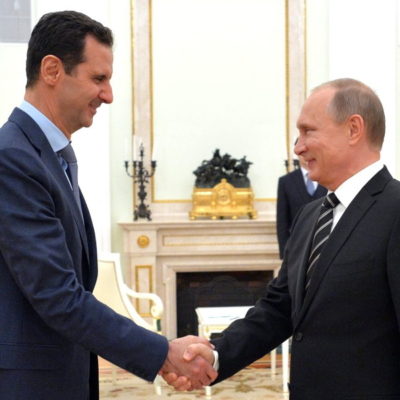
Vladimir Putin and Bashar al Assad (Source: kremlin.ru)
A year ago, President Obama opined that Russian intervention in Syria would turn into a quagmire. One year later, however, Russia is expanding and consolidating its positions and goals in Syria. Bashar Assad’s rule looks more secure than ever, buttressed by Russian weapons (including chemical weapons), intelligence, diplomatic support, and money. Moreover far from reducing its military footprint, Russia is expanding it. The Duma is about to ratify agreements essentially giving Russia permanent air bases like Hmeymim air base and Tartus. Thus Moscow, for the first time in over forty years, now has permanent bases in the Middle East, both in Syria and in Cyprus. Moreover, it is an open secret that Moscow would like to obtain a base at Alexandria like the one it had in the 1970s. In August 2016 Moscow revealed that it is now operating out of the Hamadan air base in Iran. However, within days the Iranian government pulled the plug on Russia, criticizing its inconsiderate and ungentlemanly attitude. Iranian Defense Minister Hossein Dehghan also noted that Moscow acts like and wants to show that it is a great power.[1] Obviously this episode cries out for explanation but it should not be taken as indicating that Moscow has now descended into a quagmire or, in the Russian phrase, stepped on a rake.
While this episode strongly suggests that Russo-Iranian ties are more fragile than Moscow believed, it does not disprove the fact that both sides have hitherto collaborated quite well up to this point in Syria and that they share a common objective of preserving the Assad regime in power. Iran apparently could not stand the publicity about this base and was upset that Moscow had “blown its cover” by announcing it was flying missions form Hamadan. Evidently Tehran would have preferred not to open itself up to charges from the entire Middle East (and presumably Washington) or to the domestic opposition within Iran about letting foreign powers have a military base in Iran from which they could launch sorties with impunity.  Indeed, the presence of this base was surprising for the following reasons. Moscow’s acquisition of the right to use an Iranian air base is the first time the Iranian regime has allowed any foreign military presence in Iran, something that contravenes the fundamental message of the Iranian revolution of 1979 that is the regime’s claim to legitimacy. It also represents a violation of UN Resolution 2231 forbidding foreign bases in Iran — passed as part of the 2015 deal to prevent Iranian nuclearization. It may well be the case – though we cannot be certain – that once the implications of this fact became clear to Tehran, notably that it jeopardized the continuation of the agreement with the 5+1 of 2015 regarding Iranian nuclearization and could lead to serious economic harm that second thoughts about having this base prevailed. Beyond that, this base, especially if it had continued, would have extended Moscow’s rapprochement with Tehran and the two states’ military cooperation beyond arms sales. As it is, Iran has not only now acquired the formidable S-300 surface to air anti-pair missile, it is now negotiating for Sukhoi fighter jets. And that negotiation appears to be unaffected by the decision to suspend Russian use of the base.
Russia’s and Iran’s violation of UN resolutions in this context are not totally unexpected, since Iran’s ongoing missile program is also a violation of Resolution 2231. The Russian use of incendiary weapons against civilians in Syria violates the Chemical Weapons Convention going back to 1925. Thus both Iran and Russia have ignored agreements while Washington and the international community look the other way, and are basically saying, we will do as we please whether you like it or not and you either cannot or will not do anything about it.  So while this episode suggests that Irano-Russian ties are more problematic than Moscow might have imagined, there is no reason to see here a rupture of those ties or a divide in the fundamental identity of Russian and Iranian interests regarding Syria. Nor is this an obstacle to these two governments’ further cooperation on Syria and other issues.
None of this should surprise anyone. Since Catherine the Great, Moscow has sought bases in the Mediterranean, and even the Adriatic Sea. Thus Catherine’s forces occupied Beirut for 18 months in 1772-74, and a generation later Paul I went to war on behalf of Malta, undoubtedly with similar objectives in mind. Throughout the nineteenth century Russian encroachments on the Ottoman Empire and the Balkans were a fundamental aspect of European diplomacy. In World War I, in the allied negotiations around bringing Italy into the war on the side of the Entente, Russia sought to gain a naval base through Serbia in the Adriatic. Stalin sought bases and colonies in the Mediterranean after World War II; Brezhnev obtained and lost the base at Alexandria. And now Putin has obtained the bases in Cyprus and Syria and has sought a naval base at Bar in Montenegro on the Adriatic and a land base at Nis in Serbia. Indeed, Moscow has consistently sought bases for what is now its Mediterranean Eskadra (Squadron) – even when it did not have the capacity to operate or utilize them – in order to lay down a marker, stake a claim, and force others to recognize it as a great power with a sphere of influence in the Mediterranean. These bases would also challenge NATO’s Mediterranean presence, guarantee Russian freedom of maneuver in the Black Sea, and encircle Turkey, a centuries-old Russian objective.
But the loss of the base at Hamadan does upset Russian plans. Had it been able to preserve that base, Russia would then have been able to project power constantly throughout the Levant, (the Eastern Mediterranean) and the Middle East, and force its way to an equal status with Washington in determining future security outcomes there. Apart from its logistical and tactical advantages in having a base in Iran from which to pursue Syrian targets and objectives, Moscow would also gain from a base in Iran because it could then project Russian air power all the way out to the Gulf where the US Fifth Fleet is stationed. Acquiring such a capability is a long-standing Russian objective; so Iran’s decision does strike at Russia’s larger ambitions. In 2014, Moscow indicated its desire, even well in advance of its actual naval capabilities, to project power into the Gulf and the Indian Ocean, so this base could have been a down payment on that ambition as well. Meanwhile Washington keeps appealing for Russian cooperation in Syria only for Russia to break every agreement and intensify its support for Assad to the point of using chemical weapons in Aleppo, if not elsewhere.
While Russia will undertake the occasional bombing of ISIS, it clearly is more interested in equal status with Washington in an anti-terrorist coalition against Assad’s opponents, not Washington’s. And this is the case even though ISIS clearly presents a threat to Russia by its own admission and has evidently now carried out some small-scale terrorist operations in Russia, even beyond the North Caucasus. Therefore we can expect that Moscow will use its ever-stronger position in Syria and the Middle East to coerce Assad’s opponents still further into preserving his state if not his leadership. It will also likely demand that Washington support Assad’s remaining in power, or at least his regime’s remaining in power. Moscow appears wedded to Assad personally, especially as Putin has told him that Russia would not let him down. So while there may be interludes where the attack on Aleppo is stopped for a while ostensibly for humanitarian reasons, it is most likely that the overall battle will continue on Assad’s and the Russians’ part to vanquish the insurgents and force them to accept his rule over most, if not all of Syria.
We may also expect broader diplomatic initiatives by Russia to extend its weapons and economic connections to Iran, and not only regarding the Middle East.  The revelations of a Russian base in Iran suggest as well that Moscow is looking for other bases in the greater Middle East even if this episode has had an unfortunate ending for Russia. In this context we should remember that, since “power projection activities are an input into the world order,” Russian force deployments into the greater Middle East and economic-political actions to gain access, influence and power there represent competitive and profound attempts at engendering a long-term restructuring of the regional strategic order.[2] And that region is not just the Middle East.
The recent tripartite summit with Azerbaijan and Iran clearly signals an effort to involve Iran in the latest of Russia’s transcontinental trade and transportation initiatives of a railway from Russia to Iran thorough Azerbaijan. Moscow will also undoubtedly continue to pursue expanded arms sales to Iran and endeavor to persuade Iran and other Gulf states, including Saudi Arabia, to raise energy prices by curtailing production or by some other means. Russia’s position in Syria will undoubtedly be used as leverage to induce Riyadh to accept such ideas although there are clearly no guarantees of success. We can also expect Russian efforts to insert it into schemes for a Gulf security bloc and to sell more weapons to Middle Eastern clients (e.g., Egypt and Algeria). Indeed, past experience shows that energy deals, arms sales, and the quest for Russian military bases are all intimately linked as part of a grand design. Russia will continue, for example, building an anti-access area denial air and ship capability for its Mediterranean Squadron at its bases in Syria, Cyprus, and in the Caucasus as it already is doing.
Finally, Moscow has successfully forced Turkish President Erdogan to come to St. Petersburg and fawn all over Putin, and not just for supporting him against the insurgents who tried to oust him in a coup on July 15, 2016. Erdogan now says Turkey will implement the Turkstream energy pipeline, Akkuyu nuclear plant, and engage in military-technical cooperation with Russia. Indeed, Foreign Minister Mevlut Cavusoglu has offered many recent statements attacking NATO, and all but saying that Turkey will buy weapons in the future from Russia among other producers. Both sides are also establishing a mechanism for ongoing military-intelligence coordination, supposedly against ISIS. Apart from this Russo-Turkish cooperation against ISIS there are signs that Turkey might have to agree to a “decent interval” for Assad to stay in power before leaving as part of a projected settlement. Yet Putin has certainly not stopped supporting the Turkish or Syrian Kurds whom Ankara suspects of having committed recent terrorist attacks in Turkey. Neither is Russia going to be deterred from supporting Assad, and it will only lift its economic sanctions on Turkey dating back to the end of 2015 only gradually. Meanwhile Turkish officials have more than once hinted at offering Moscow access to Incirlik Air Base. Therefore it is hardly surprising that there are mounting reports in the media sounding alarms that Turkey is in fact compromising its membership in NATO as Erdogan ruthlessly moves to stamp out all opposition and re-establish an authoritarian-cum-Islamist state in Turkey rather on the model of what Putin has done in Russia.
Even with losing the base in Iran Russia has achieved virtually all of its strategic aims in Syria including some it had not originally sought or expected. In addition we also see the evisceration of the pro-Western Kemalist Turkey, the expansion of Russian military power throughout the Middle East – even if that expansion has hit a temporary bump in the road – and the continuing disarray – to put it mildly – of U.S. policy. Indeed, insofar as Syria is concerned, it is not inaccurate to say that Washington neither has a strategy, nor a coherent policy, or any idea how to use the instruments of power at its disposal to achieve anything in Syria. One year after intervening, Putin – rather than entrapping himself in a quagmire – has achieved his avowed political and military objectives: coordinating with virtually every Middle Eastern state, exposing the fatuousness of U.S. policy, forcing Washington to accept its leadership in Syria, and establishing permanent and expanding military lodgments, all at a very low and affordable cost. Indeed, it is the U.S. that appears to be in a quagmire in Syria, not Russia. Given this unbroken and consistent series of successes for Putin in the Middle East, the prospect of a Russian quagmire seems low.
·         * This article was published first by Foreign Policy Research Institute on August 23, 2016
·         * Stephen Blank is a Senior Fellow at the Foreign Policy Research institute as well as at the American Foreign Policy Council.


Saturday, July 30, 2016

The Right Target For The U.S. In Syria: Hezbollah

By Daniel Serwer

Image result for hezbollah
Hezbollah is the right target of U.S. in Syria

The military situation in Syria has turned against the U.S.-supported opposition over the past year, due mainly to Russian intervention. Now, the failed coup in Turkey and subsequent crackdown there stand to reduce the capabilities of a key U.S. ally. Without some rebalancing now in favor of the opposition to Syrian dictator Bashar al-Assad, the prospects for a satisfactory negotiated political transition are dim.

In a dissenting internal memo last month, 51 State Department diplomats advocated attacks on Syrian government forces to end their aggression against the country’s civilian population, alter the military balance and bring about a negotiated political solution. President Obama has focused instead on fighting terrorism in Syria, but U.S. targets are limited to Sunni extremists such as the Islamic State and al-Qaeda affiliates.

There is also a Shiite terrorist organization in Syria: Lebanon-based Hezbollah. It should not be immune.

Hezbollah was founded to resist the Israeli occupation of Lebanon in the early 1980s and takes credit for the eventual Israeli withdrawal from that country. Tightly allied with and supported by Iran, it has become the dominant political force among Shiites in Lebanon, where it not only participates in national politics but also runs its own security forces and provides social services to Shiite populations.

Covertly since 2012, and overtly since 2013, Hezbollah has deployed forces inside Syria, where its thousands of fighters are aligned with Assad’s army and mainly Shiite and Alawite militias against mainly Sunni forces that Assad regards as terrorists. The Iranian Revolutionary Guard Corps pays Hezbollah’s bills and provides its command-and-control operations. Hezbollah forces have been particularly effective along the border with Lebanon, which provides it with strategic depth and supply lines.

Hezbollah is a major factor in the military balance in Syria. Along with the Russian air intervention begun last September and the Iranian Revolutionary Guard, Hezbollah’s fighters have enabled Assad to make progress against his opponents, especially those associated with the Free Syrian Army fighters backed by the United States. That progress has hardened Assad’s negotiating stance and blocked the U.N. search for a political solution. Assad is winning, and he sees no reason to accept a transition away from his rule.

A shift in the military balance is essential to ending the war, which is what Washington says it wants. But Obama has steadfastly refused to go to war against the Syrian, Iranian or Russian government. Even if he wants to, it is doubtful he has authorization from Congress to do so.

But Hezbollah is a non-state actor. It is also a U.S.-designated terrorist group that has murdered Americans, among many others. Most Republicans and Democrats would applaud an attack on Hezbollah, even if some in both parties would bemoan a move that suggested widening commitments overseas.

Washington could inform Tehran, Moscow and Beirut that Hezbollah should withdraw from Syria by a certain date or the United States would target any of its troops attacking non-extremist opposition forces in and around Aleppo and elsewhere. If Hezbollah failed to withdraw, the United States would then need to be ready to attack as soon as the ultimatum expired.

Hezbollah’s withdrawal or U.S. targeting of Hezbollah would send a strong but still limited message to the Syrian opposition and its allies in Turkey and the Persian Gulf: We are prepared to attack Shiite as well as Sunni terrorists, but it’s up to you to take advantage of the opportunity and come to the negotiating table ready to reach a serious political settlement. It would also send a strong but likewise limited message to Iran and Russia: We will not continue to tolerate your intervention in Syria without responding. The time for a political settlement is now.

How would the players in Syria react? Hezbollah would likely try to strike at accessible U.S. assets or citizens in neighboring countries, most likely in Lebanon or Iraq. It might also launch rockets into Israel. The Islamic State, which uses Hezbollah’s involvement in Syria as a recruiting tool, would be undermined. Russia and Iran could in theory up the ante, escalating their involvement in Syria, but in practice they both appear to be close to the limit of lives and treasure they are willing or able to expend there. Assad would be outraged and promise revenge, but the Syrian government is even more clearly at the limit of its capabilities.

Meanwhile, the non-extremist Syrian opposition would applaud and press hard against the territory where Hezbollah is deployed. Gulf states would likewise welcome the U.S. action and redouble their efforts to support the opposition. Israel knows all too well how to react to Hezbollah attacks in order to re-establish deterrence. Turkey might complain that the United States was not also acting against the U.S.-allied Kurdish fighters whom Ankara regards as terrorists, but the Turks would still benefit from any consequent military progress against Assad by non-Kurdish forces.

In short, U.S. targeting of Hezbollah would mostly please and embolden Washington’s friends and discomfit its antagonists. It would also reassert U.S. commitment to fighting terrorism of all sorts, renew Washington’s commitment to holding Hezbollah accountable, hasten an end to the Syrian civil war and make a political settlement more likely. That is not a bad balance of risks and benefits.


* The writer is a professor and director of the conflict management program at the Johns Hopkins School of Advanced International Studies, as well as a scholar at the Middle East Institute.
* This opinion was published first by Washington Post on 27/07/2016

Thursday, July 28, 2016

Obama's Exit Calculus On The Peace Process

By  

U.S. President Barack Obama (R) greets Palestinian President Mahmoud Abbas (L) and Israeli Prime Minister Benjamin Netanyahu, as leaders gathered to deliver a joint statement on Middle East Peace talks in the East Room of the White House in Washington September 1, 2010. REUTERS/Jason Reed
US President Obama with President Mahmoud Abbas and Prime Minister Benjamin Netanyahu

As the Republican and Democratic parties convene in Cleveland and Philadelphia, we expect to see numerous signs of the deepening polarization that has dominated this campaign season. One issue that has traditionally shared bipartisan support is how the United States should approach the Israeli-Palestinian conflict. However, this year both parties have shifted their positions farther from the center and from past Democratic and Republican platforms. This swing impacts whether the Obama administration, which has devoted significant time and resources to the negotiations, will issue a parting statement on the conflict.
In Cleveland last week the Republican party adopted a platform entirely dropping the two-state solution to the Israeli-Palestinian conflict, a move that puts the party further to the right than either AIPAC or Israeli Prime Minister Benjamin Netanyahu. The platform states, “We reject the false notion that Israel is an occupier and specifically recognize that the Boycott, Divestment, and Sanctions Movement (BDS) is anti-Semitic in nature and seeks to destroy Israel.” This language, combined with Republican nominee Donald Trump’s apparent disinterest in the conflict, makes it unlikely a Trump administration would prioritize Israeli-Palestinian issues or make any serious attempt at negotiations.
Conversely, this year’s Democratic Party platform reaffirmed the United States government’s long-standing commitment to seeking a two-state solution in the region. But the party took a notably progressive turn, highlighting both the importance of Israel’s Jewish and democratic future and Palestinian freedom “to govern themselves in their own viable state, in peace and dignity.” The contentious fight over the Democratic Party language, combined with Democratic nominee Hillary Clinton’s (and her potential First Gentleman’s) passion for this issue reveals an intent by a future Clinton administration to reinvigorate negotiations.
As President Obama and Secretary Kerry consider their final months in office, one item on the agenda is whether to push a last-ditch effort on the issue—either by releasing some sort of Obama or Kerry Parameters based on the outcome of the failed 2013-14 negotiations or by supporting one of the international initiatives such as the French Initiative, the Quartet Report, or the regional Arab Peace Initiative, now spearheaded by Egyptian President Abdel-Fattah el-Sissi.
Likely to drive the administration’s calculus are the Democratic and Republican nominees and their political motives on the U.S. led peace process. The time to watch for a potential move, therefore, is between November and January. Given the administration’s support for its own party’s nominee, it is in Obama’s interest to keep the peace process on life support—but without resuscitating it—through January. Publicly, but somewhat unenthusiastically, supporting the various international initiatives and allowing other states and international organizations to sit in the driver’s seat sets a future Democratic administration up with the best chance of success.
Lessons from getting Israeli and Palestinian leaders to the table over the years include the wisdom to refrain from yelling about past progress in negotiations. Publicly revealing how far Netanyahu and Abbas were willing to go in 2014 would only harm the next administration’s efforts at resuming negotiations. Keeping the “Kerry Framework” in the administration’s pocket allows a Clinton administration to take ownership of the peace process should she be elected.
Alternatively, if Trump is elected, the Obama administration would have nothing to lose in revealing the fruits of its efforts in 2013-14. The administration would have little concern for derailing a possible Trump attempt (which is not likely to take place in any event) and could determine that releasing some sort of Obama or Kerry Parameters would shed a positive light on the administration’s legacy. Furthermore, should the Republican Party win the White House, neither Obama nor Kerry is likely to care about the damage that releasing such a document might do to either Netanyahu or Abbas.
The party conventions have solidified the deep divides—both between and within the parties—regarding the U.S. approach to the Israeli-Palestinian conflict this campaign season. This divide, combined with a renewed international focus on the conflict, virtually guarantees that the administration will keep the conflict on the back burner before November. The election, therefore, will not only determine our next president but also the fate of the “Obama/Kerry Parameters”.
·       *   Note: Ariella Plachta, an intern with the Center for Middle East Policy, contributed to this post.
·       * Sarah Yerkes is a visiting fellow in the Center for Middle East Policy and a Council on Foreign Relations International Affairs fellow. She is a former member of the State Department’s policy planning staff, where she focused on North Africa. Previously, she was a foreign affairs officer in the State’s Department’s Office of Israel and Palestinian Affairs.

·         * This post originally appeared on the Israel Policy Forum’s blog, Matzav on| 

Wednesday, July 27, 2016

The Misconceptions of Israeli-Gulf Cooperation


Prince Turki al-Faisal with Yaakov Amidror

Much has been made, particularly by Israelis, of the expanding horizons for collaboration between the Jewish state and Arab Gulf states. Israeli ministers and business people lose no opportunity to tout Israel’s interest in expanding ties of all sorts in a region viewed as a valuable market for Israeli industry and an intelligence gold mine.
Meetings that once were held in the dark are now on public display. Relations that were once conducted solely by intelligence officials now feature diplomats and the formal establishment of relations with countries such as the U.A.E. 
In a notable development, Saudi Arabia won key recognition from Israel—and Egypt and the United States—as a strategic partner in regional security in the Straits of Tiran. Such achievements expose not only the alluring prospects of such a dialogue, but also its enduring, critical limitations.
The nascent coalition linking Israel with the Gulf was born as a coalition of countries that are united by their common failure to dissuade Washington from its path of rapprochement with Iran.
Washington and Tehran just celebrated the one-year anniversary of the J.C.P.O.A., which remains the signature foreign policy achievement of the Obama administration. Saudis and Israelis looking to roll it back must contend with the fact that, in an era when the Middle East is shaking under their feet, the Iran deal represents a relative rock of stability and policy achievement unmatched elsewhere in U.S. efforts in the region. Washington’s relations with Tehran may not blossom, but they will be difficult to reverse—a fact that critically weakens the foundations of underlying Israeli-Gulf cooperation and limits the effectiveness of an ‘alliance’ based upon undermining the principal diplomatic and strategic achievement of your indispensable, superpower ally.
It is also true that one need only scratch the surface to reveal vital differences in Israeli and Saudi views on Iran itself. Israeli bluster aside, considered Israeli opinion and policy is far more sanguine about Iran than is the case in Riyadh.
Even at the height of concerns about an Israeli military strike against Iran’s nuclear infrastructure, Israel’s security establishment successfully tamed the wilder, undisciplined instincts of many in Israel’s political class. The generals have long understood the vitality of Israel’s strategic superiority and are prepared to accommodate an American-led deal with Tehran in a fashion that contradicts visceral Saudi opposition to the mullahs.
Such differences are apparent in other arenas as well. This is certainly the case concerning Syria, where the prevailing Israeli view is sympathetic to the Assad regime.  As a consequence of its understandings with Russia, agreed-upon limits have been set to Iranian and Hezbollah deployments—a display of realpolitik toward the Damascus regime that Riyadh is loathe to adopt.  
For Israel, its problems with Iran are of relatively recent vintage. In contrast, it retains a historic and strategic interest in limiting Arab power—an interest that stands in opposition to declared Arab objectives. Israel’s newfound Arab friends must be ready to address the unexpected, destabilizing pressures that will result from an Israel freed from any concern about constraining Arab power—in Palestine and Lebanon in particular.
In Lebanon, Israel and Gulf states have a shared antipathy toward Hezbollah, but there is no interest in Arab support for an Israeli military campaign in Lebanon or more improbably Syria.
Similar considerations illustrate the limits of Arab understanding of an aggressive Israeli policy toward Gaza.
Israel’s response to the Arab Peace Initiative is also an instructive case in point.
Long ignored by Israeli leaders—Ehud Olmert did not even bother to read it—Israel’s strategy is to pocket the historic promise of peace with the Arab and Islamic worlds as simply a basis for further discussion.
More broadly, Israel has turned the historic formula at the heart of A.P.I.—peace with Palestine is a gateway to rapprochement with the Arab world—on its head. “The Arab Peace Initiative,” explained Saudi prince Turki al-Faisal in a public discussion with former National Security director Yaakov Amidror, “is the formula that can bring us together. But the general [Amidror] sees otherwise. He wants us to start cooperating with Israel, and do whatever is done in that journey, and forget about the occupation of Palestine and various other issues that deal with the daily occurrences that are taking place on the ground in Palestine, whether it is expansion of Israeli settlements in the West Bank, whether it is the roadblocks — all the issues that you are all aware of.”
Jordan is another useful example of both the advantages and built-in shortcomings of such an Arab strategy. Egypt and Jordan enjoy relations with Israel based upon signed peace treaties. Yet even this achievement has not been sufficient to shield either country from dramatic challenges posed by Israel.
There has been an indirect Israeli security umbrella over Jordan since Black September 1970. This protection, however, has failed to pay dividends for Jordan on the Palestine front. Indeed, in terms of national security threats, the prospect of a Palestinian retreat to Jordan—pushed by Israeli policy unfettered by Arab or international pressure—is a constant source of concern to Jordanian officials. And among Israelis, there is a long and widely held view that considers a Palestinian takeover of Jordan and the demise of the Hashemites to be an Israeli interest, and only a matter of time.
With Egypt, there are many indications that relations with Israel have never been closer. This honeymoon is fueled, however, by unprecedented national security challenges  suffered by Egypt in Sinai. Israel’s unilateral retreat from Gaza in 2005, its serial wars there since, and the attendant effort to force Egypt to assume the burden of Gaza’s welfare, illustrate the limits of their cooperation.
A long, long road has been travelled since the famous ‘three no’s of Khartoum’—no recognition, no negotiations, no peace—in the aftermath of the June 1967 war. The iron wall separating Israel from its Arab neighbors is indeed showing cracks, but the prospects for a turn from confrontation to cooperation is still hampered by real differences of interests and priorities.

* Geoffrey Aronson writes about Middle East affairs. He consults with a variety of public and private institutions dealing with regional political, security, and development issues. He has advised the World Bank on Israel’s disengagement and has worked for the European Union Coordinating Office for the Palestinian Police Support mission to the West Bank and Gaza.