Tuesday, July 31, 2012

Tehran Takedown

Focusing on Iran's nuclear program misses the point. Defending the United States and its allies from Iran and its proxies requires regime change in Tehran, which cannot be achieved with sanctions and diplomacy alone. Since war is neither necessary nor desirable, Washington should start backing a domestic revolution in Iran.

By Michael Ledeen
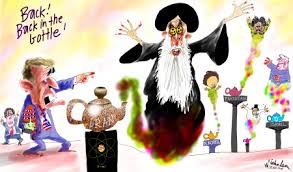


The nuclear question is at the center of most countries' Iran policies. China, France, Germany, Russia, the United Kingdom, and the United States have all engaged in negotiations to convince Tehran to give up its presumed quest for the bomb. Now, with talks sputtering, Western powers have implemented increasingly tough sanctions, including the European Union's recent embargo on Iranian oil, in the hope of compelling the regime to reverse course.

Yet history suggests, and even many sanctions advocates agree, that sanctions will not compel Iran's leaders to scrap their nuclear program. In fact, from Fidel Castro's Cuba to Saddam Hussein's Iraq, hostile countries have rarely changed policy in response to Western embargoes. Some sanctions advocates counter that sanctions did work to get Chile to abandon communism, South Africa to end apartheid, and Libya to give up its nuclear program. But the Chilean and South African governments were not hostile -- they were pro-Western, and thus more amenable to the West's demands. And Libya's Muammar al-Qaddafi ended his nuclear pursuit only after the 2003 U.S. invasion of Iraq, fearing that he would suffer the same fate as Saddam Hussein.

Iran, which is clearly hostile and which watched what just happened to a disarmed Libya, will not back down. Some therefore see sanctions as only a prelude to military action -- by Israel, the United States, or both. In other words, current Iran strategy boils down to an eventual choice between appeasement and attack. Neither outcome is attractive. However, if the United States and its allies broadened their perspective and paid attention not merely to Iran's nuclear program but also to the Islamic Republic's larger assault on the West, they would see that a third and better option exists: supporting a democratic revolution in Iran.

Obsession with the nuclear question has obscured the fact that, since the 1979 Islamic Revolution, Iran has waged a low-level war on the United States. That war began in earnest in 1983, when, evidence suggests, Iranian-backed operatives bombed the U.S. Marine barracks in Beirut. Such violence continued throughout the 1980s, as Hezbollah, a terrorist organization created by Iran, kidnapped and murdered Americans in Lebanon. In addition to supporting Hezbollah, Iran started funding other terrorist groups, such as Hamas, Islamic Jihad, and the Popular Front for the Liberation of Palestine. In the last decade, Iranian agents have attacked U.S. troops in Afghanistan and Iraq. Late last year, the Obama administration revealed that Iranian agents had attempted to assassinate the Saudi Arabian ambassador to the United States and to blow up the Saudi and Israeli embassies in Washington, D.C.

In short, the nuclear program is not the central issue in Iran policymaking -- defending the United States and its allies from Iranian terrorists and their proxies is. To meet that goal, Washington must replace the Islamic Republic's regime. The theocrats in Tehran call the United States "the great Satan," and waging war against it is one of the Iranian leadership's core missions. The Ayatollah Khomeini proclaimed that as his goal very soon after the shah was overthrown in 1979. Calls of "Death to America" have been a constant refrain ever since. Regime change cannot be achieved by sanctions and diplomacy alone. And, although war might bring down the regime, it is neither necessary nor desirable. Supporting a domestic revolution is a wiser strategy.

The Iranian regime is not only at war with the United States and its allies; it is also at war with its own people. The regime represses Iranian citizens, restricting their civil liberties and imprisoning, torturing, and killing political opponents. Popular discontent boiled over into open protest after a rigged election in June 2009, as what came to be known as the Green Movement launched an open challenge to the political status quo. The regime brutally suppressed the protests and is keeping the movement's two leaders, presidential candidates Mir Hossein Mousavi and Mehdi Karroubi, along with Mr. Mousavi's wife, under house arrest.

Conventional wisdom describes the Green Movement as a spent force, citing the lack of mass demonstrations over the past year and half. Iranian authorities regularly restrict and censor the Internet and intercept and block cell phone and satellite communications, and they have increased deployments of security forces in cities across the country. In such an atmosphere, skeptics argue, there can be little opposition to speak of, let alone one with the leadership and mass support to challenge the regime.

But this was also the conventional wisdom back in early 2009, and it is as wrong now as it was then. The West was caught unawares by the explosion of popular rage after Mousavi's election was stolen, and it failed to support the opposition. The regime paid no price for its crackdown.

In fact, despite the government lockdown, dissenters today have continued to strike out against the regime through acts such as the sabotage of oil and natural gas pipelines. The disruption of the natural gas line between Iran and Turkey in late June, which was reported by the state-run Press TV, is only the latest of many such attacks. Last March, opposition activists privately claimed responsibility for attacks on two Revolutionary Guards Corps installations. One was Zarin Dasht, where missile fuel and warheads are manufactured. The other was Natanz, a major uranium enrichment center. The explosion took place deep underground, leading to a shutdown of the entire complex.

Meanwhile, although the Green Movement's leaders are still under house arrest, they continue to issue statements to their supporters. And according to a recent online government poll, the population is fed up. Nearly two-thirds of respondents said that they favored giving up the nuclear program in exchange for an end to sanctions. The poll was quickly yanked off the Web site.

For their part, Iranian authorities are worried. In January, Ali Saeedi, Khamenei's representative to the Islamic Revolutionary Guards Corps, admitted that the regime continues to fear the strength of the Green Movement. Regime leaders are at pains to reassure the public that Mousavi and Karroubi are being well treated. If Iranian Supreme Leader Ayatollah Ali Khamenei wanted to demonstrate the weakness of the opposition, he would have subjected both to the same harsh treatment that has been meted out to many of their followers. But as Saeedi told Fars, the Iranian state news agency, Mousavi and Karroubi have "supporters and followers," as well as "a few [clerics] who continue to back elements within the sedition" -- the term used by the regime to refer to the Green Movement.

The regime's anxiety about the Green Movement also led it to delay all elections in the country for three years. And when it finally held parliamentary elections this past May, it banned scores of candidates from running and deployed thousands of security forces at polling stations to prevent protests. Their fear might also be the reason that Khamenei avoided speaking at the Revolutionary Guards Day festivities in late June, the first time he had done so in over two decades. Similarly, the regime has reduced the number of anti-American protests it stages, perhaps worrying that the reformers would hijack them. When two popular (and apolitical) Iranian artists died this summer -- the actor Iraj Ghaderi and the musician Hassan Kassai -- their funerals were held without fanfare and in the middle of the night. The regime is clearly doing all it can to keep Iranians from gathering in the streets.

By themselves, the strength of the opposition and the regime's fears do not justify Western intervention. After all, several Middle Eastern dictators have fallen of late, only to be replaced by actors more hostile to U.S. interests. And some experts contend that the same could happen in Iran. Mousavi served as prime minister of Iran from 1981 to 1989 and played a key role in the creation of the Islamic Republic. Many, including U.S. President Barack Obama, have raised the possibility that his accession might not change much. So, before jumping into the fray on behalf of the opposition, the United States and its allies must ask whether the Green Movement would end Iran's support for terrorism against the United States and its allies, stop oppressing its own people, and terminate the country's nuclear weapons program.

Although it is dangerous for opposition leaders to be totally explicit about all such matters, their answers are encouraging. During the 2009 electoral campaign, and on several subsequent occasions, Mousavi promised to end Iranian backing for terrorist organizations -- a promise that resonates with large numbers of Iranian citizens. In February 2011, demonstrators carried banners decrying the regime's support for foreign terrorist groups, with slogans such as "Don't talk to us about the Palestinians, talk about us."

The Green Movement has also pledged to dismantle many oppressive practices of the Islamic Republic. Although the group's leaders claim that they want to restore the values of the 1979 revolution, during the 2009 presidential election, Mousavi's wife, Zahra Rahnavard, campaigned alongside him and declared her support of women who dispense with wearing the veil. It was a stark act of defiance against a deeply misogynistic regime. Mousavi, meanwhile, has promised tolerance of religious dissenters, the release of all political prisoners, and greater separation of church and state. As the Green leaders wrote to the Obama administration in November 2009, "religion, by the will of the Iranian people of today, has to be separated from the state in order to guarantee unity of Iran."

Even from house arrest, Mousavi has continued to send signals that he would overturn the policies of the current regime. In the past year, he urged Iranians to read two books: News of a Kidnapping, by Gabriel Garcia Marquez, and The Right to Heresy, by Stefan Zweig. The first volume, which deals with a wave of kidnappings in Colombia by drug gangs, inspired a popular Iranian Facebook page called "News of a Kidnapping, the status of a president in captivity." The second book addresses a revolt against John Calvin by the sixteenth century cleric Sebastian Castellio, after the torture and execution of the heretic Michael Servetus. It is at once a call for religious toleration and an essay on those thinkers who were crushed during their lifetime, only to emerge triumphant in death. By turning to these texts, Mousavi issued a direct challenge to Khamenei and oriented his movement with Western values.

It is hard to pinpoint the nuclear intentions of the Green Movement's leaders, but there is reason for guarded optimism; they have repeatedly condemned the regime's "adventurism" in foreign affairs, and would certainly seek better relations with the West. As Iranian crude oil production drops, a democratic Iran might opt for nuclear energy, but it seems unlikely that such a government would continue the secret weapons program. And the West, including Israel, would have far less to fear from a free Iran, whatever weapons it might possess, than it does from the current regime.

Given the potential for a successful democratic revolution in Iran -- and the potential for a democratic government to end Iran's war against us -- the question is how the United States and its allies can best support the Green Movement.

Although an Iranian revolution may seem unlikely to the casual observer, the Iranian people can be said to have revolution in their DNA, having carried out three revolutions in the twentieth century. Many skeptics argue that any Western aid to the Green Movement would delegitimize it in such a nationalist country. Yet, during the mass demonstrations in 2009 and 2010, protesters waved signs and banners saying "Obama, where are you?" Moreover, in a carefully unsigned letter to the White House in late 2009, Green Movement leaders responded to an administration query by saying that "it is up to the countries of the free world to make up their mind. Will they... push every decision to the future until it is too late, or will they reward the brave people of Iran and simultaneously advance Western interests and world peace?"

Even so, the West snubbed the uprising, insisting that the Iranian opposition did not want outside help. As far as I know,  there is no evidence to suggest that an attempt has been made since then to speak directly with the Green Movement inside the country. (Mousavi has said several times that the Green Movement does not have spokespeople or representatives outside Iran.) Unable or unwilling to engage with the opposition, the West has devoted its energy to the nuclear question alone, pursuing a policy that will produce war or diplomatic and strategic failure.

That is why the time has come for the United States and other Western nations to actively support Iran's democratic dissidents. The same methods that took down the Soviet regime should work: call for the end of the regime, broadcast unbiased news about Iran to the Iranian people, demand the release of political prisoners (naming them whenever possible), help those prisoners communicate with one another, enlist international trade unions to build a strike fund for Iranian workers, and perhaps find ways to provide other kinds of economic and technological support. Meanwhile, the West should continue nuclear negotiations and stick to the sanctions regime, which shows the Iranian people resistance to their oppressive leaders.

Iran's democratic revolutionaries themselves must decide what kind of Western help they most need, and how to use it. But they will be greatly encouraged to see the United States and its allies behind them. There are many good reasons to believe that this strategy can succeed. Not least, the Iranian people have already demonstrated their willingness to confront the regime; the regime's behavior shows its fear of the people. The missing link is a Western decision to embrace and support democratic revolution in Iran -- the country that, after all, initiated the challenge to the region's tyrants three summers ago.

-This article was published first in Foreign Affairs on 31/07/2012

It Ain't Just A River In Egypt

Egyptian liberals lost badly in the post-revolution scramble for power -- and now they're in deep denial as many embrace conspiracy theories about the United States.

BY SHADI HAMID


When Defense Secretary Leon Panetta pulls up to the U.S. Embassy in Cairo this week, he will see a protest outside its walls. Just steps away from Tahrir Square, supporters of Omar Abdel Rahman have been staging a sit-in for nearly a year to protest the imprisonment of the man known as the "Blind Sheikh," who is serving a life sentence in a North Carolina prison for planning terrorist attacks on American soil.

Upon Secretary of State Hillary Clinton's visit just weeks before, these protesters were joined on the embassy's doorstep by a group often seen as more sympathetic to U.S. values and policies: Egypt's liberals. This time, they had lost some of that sympathy.

The protests, by themselves, weren't entirely unexpected -- after all, no one in Egypt these days seems to have much praise for President Barack Obama's administration. And liberals, due to their perceived closeness to the West, have often had to overcompensate to shore up their nationalist bona fides. After all, it wasn't the Muslim Brotherhood but, rather, liberal standard-bearer Amr Hamzawy who refused to meet in February with Sen. John McCain due to his "biased positions in favor of Israel and his support for invading Iraq and attacking Iran."

What is different about this most recent surge in anti-Americanism is its conspiratorial bent. Some of Egypt's most prominent liberal and leftist politicians are telling anyone who will listen that the United States is in bed with the Islamists. Such allegations would be concerning on their own, but they're even more troubling for what they represent -- Egyptian liberals' growing ambivalence and even opposition to democratic rule. The rise of what we might call "undemocratic liberals" is threatening Egypt's fledgling democracy.

The suspicion that the United States is secretly supporting the Muslim Brotherhood sounds far-fetched, in part because it is. I remember first hearing a variation on the theory from a top Egyptian official in January: He spoke at some length of a U.S. master plan to install a grand Islamist alliance in government, including not just the Brotherhood but also more radical Salafists. Initially, I thought he might be making a meta-commentary on the absurdity of conspiracy theories. He wasn't.

Over the course of Egypt's troubled transition, liberal resentment has only grown. This month, former presidential candidate Abul-Ezz el-Hariri claimed that the Obama administration was backing the Brotherhood so it could then use the establishment of Egyptian theocracy as a pretext for an Iraq-style invasion. Most of the allegations, however, have not aspired to the same level of creativity. Emad Gad of the Social Democratic Party, a leading liberal party, asserted that the United States was "working with purpose and diligence in order to enable the forces of political Islam to control the institutions of the Egyptian state."

It was Gad who would capture in a few choice words the newfound merger of anti-Americanism and anti-democratic sentiment. "It's an Egyptian issue. It's not for the secretary of state," he told the New York Times. "We are living in an unstable period. If the SCAF [Supreme Council of the Armed Forces] goes back to its barracks, the Brotherhood will control everything."

Liberals' fears have increasingly dovetailed with those of Egypt's Coptic Christian community, which makes up perhaps 10 percent of the population and is understandably suspicious of the Muslim Brotherhood, after decades of ambiguous statements on minority rights. On the first day of Clinton's visit, four of the country's leading Coptic figures released a statement saying, "Clinton's desire to meet Coptic politicians after having met with the Muslim Brotherhood and Salafi leaders is a kind of a sectarian provocation which the Egyptian people and Copts in particular reject." It has reached the point, they wrote, where the United States had backed one candidate -- referring to the Muslim Brotherhood's Mohamed Morsy -- in the presidential election.

The belief that the United States was behind Morsy's victory has spread among anti-Brotherhood groups. Before the final election results were announced on June 24, a coalition of leading liberal parties held a news conference condemning the Obama administration for backing Morsy's candidacy. "We refuse that the reason someone wins is because he is backed by the Americans," said the Democratic Front Party's Osama el-Ghazali Harb, who was an influential figure in former President Hosni Mubarak's ruling party before resigning in 2006.

In all these examples, no evidence was provided to substantiate the allegations, in part because no such evidence exists.

When asked to explain how they came to believe in a U.S.-Brotherhood "deal," Egyptians point to innocuous pro-democracy statements from U.S. officials, such as Clinton urging that the Egyptian military "turn power over to the legitimate winner" of presidential elections. One organizer of the anti-Clinton protests, the Free Front for Peaceful Change, accused the United States of attempting to "impose its hegemony" on Egypt because of a July 4 statement by U.S. Ambassador to Egypt Anne Patterson in which she said, "The return of a democratically elected parliament, following a process decided by Egyptians, will also be an important move forward."

A cui bono conspiratorial mindset has taken hold. The United States says it supports a "full transition" to democracy. The Brotherhood, being the largest, best-organized party in Egypt, naturally stands to benefit most from such a transition. This, in turn, must mean that the United States supports the Brotherhood. In other words, more democracy means more Islamism, so anyone who advocates the former is suspected of supporting the latter. The very notion of democracy is becoming politicized.

The Brotherhood, the closest thing Egypt has to a majority party, is, unsurprisingly, a rather staunch advocate of majority rule. On this point, Morsy and other leading Brothers have straddled the fine line between democracy and demagoguery. For many Egyptians, Morsy's dramatic, chant-like chorus of "there is no power above the people" during a June 29 speech in Tahrir Square was a stirring ode to popular sovereignty. For others, it was a sign that the Brotherhood -- having won 47 percent and 52 percent in parliamentary and presidential elections, respectively -- felt it had the right to implement its vision, regardless of what anyone else had to say about it.

Turkey's experience is instructive here, though less as a model than a cautionary tale. Upon assuming power in 2002, the Islamically oriented Justice and Development Party (AKP) understood that the best way to promote religion in public life was to promote democracy, which would allow it to wrest power away from Turkey's entrenched secular establishment. Despite the anti-Western orientation of its Islamist predecessors, the AKP latched on to the European Union accession process, which required Turkey to reduce the powers of the military and lift restrictions on freedom of expression, including on religious issues. It was odd that those three things went together -- better relations with the West, democracy, and Islamization -- but in Turkey's case they did.

But just like in Egypt, the backlash from Turkey's liberals was harsh. The opposition Republican People's Party and other secularists adopted an increasingly anti-American and anti-European posture, resisting many of the reforms the AKP was hoping to implement. The staunchly secular military, which had traditionally seen itself as a Europeanizing force in Turkish politics, also underwent a striking evolution. As Turkish scholar M. Hakan Yavuz noted in a 2002 article, "One of the newest characteristics of the Turkish military in the late 1990s is its willingness to employ anti-Western rhetoric and accuse opponents of being the 'tools of Europe' because of growing pressure from the European Union on human rights and the need for civilian control."

EU accession was no longer in the interests of the military, and perhaps it never really was. In Turkey, like in Egypt, more democracy meant, inevitably, more religion. Turkey's secular establishment turned out to be much more secular than it was democratic -- and Egypt is looking as if it may go down the same path.

The question is often posed: Do Islamists really believe in democracy? The more relevant matter for Egypt, at least for now, is to understand how would-be democrats like Gad and Harb have strayed from the very ideals they claimed to be fighting for.

Some blame, of course, must be laid at the feet of the Muslim Brotherhood. As Egypt's most powerful political force, the movement had a responsibility to rise above partisanship and do more to reassure its skeptics. But the Brotherhood thought it was strong enough to dismiss liberals, and liberals were too weak to put up a fight through the electoral process. What sometimes seems like a massive ideological divide is really about power.

So too is the increasingly bizarre speculation about America's hidden designs in Egypt. Roger Cohen, a New York Times columnist, writes that conspiracy theories are "the ultimate refuge of the powerless." So in failing to win -- and feeling like an embattled minority in the process -- liberals have looked to the United States and other unnamed "foreign hands" to explain the rise of their Islamist opponents.

The irony is that the Obama administration, while willing to engage the Brotherhood, has itself been wary of the Islamists' rise to power. For much of the transition, the United States stood by the SCAF, the ruling military junta and the Brotherhood's archrival. The Egyptian military was a known quantity, the linchpin of the 30-year U.S.-Egypt relationship and a force for regional stability. The generals, the thinking went, would ensure that vital American interests were protected. When SCAF waged an unprecedented crackdown on civil society and threatened several American NGO workers with jail time, the United States sought a face-saving compromise and kept the $1.3 billion in annual military aid flowing. Even in her recent visit, Clinton avoided any direct criticism of SCAF, despite the latter staging an effective coup -- dissolving the democratically elected parliament and stripping the presidency of its powers -- just weeks prior.

The hostility of Egypt's secular establishment presents the United States with something of a dilemma. If it ever does get serious about pressuring the military and promoting democracy in Egypt, the more liberals -- perhaps its most natural allies -- will cry foul. This no-win situation will likely persuade U.S. policymakers that it's better to stay away and do less rather than more. In this sense, liberal conspiracy theories, as absurd and creative as they might be, may be hitting their mark -- pushing the United States and other outside actors out of Egypt. That is probably good for Egypt's liberals, but not necessarily for Egypt.

-This commentary was first published in Foreign Policy in 30/07/2012
-Shadi Hamid is director of research at the Brookings Doha Center and a fellow at the Saban Center for Middle East Policy at the Brookings Institution

Monday, July 30, 2012

Splitting Al-Qa'ida And Its Affiliates

The following article was adapted from the author's recently released report, "Breaking the Bonds Between al-Qa'ida and Its Affiliate Organizations."

By Daniel Byman


The death of Osama bin Ladin and the fall of Arab dictators have left al-Qa'ida's leadership in disarray, its narrative confused, and the organization on the defensive. One silver lining for al-Qaida, however, has been its affiliate organizations. In Iraq, the Maghreb, Somalia, Yemen, and elsewhere, al-Qa'ida has used local groups to expand its reach, increase its power, and grow its numbers. This string of mergers is not over. In places as diverse as the Sinai Peninsula and Nigeria, al-Qa'ida-linked organizations are emerging. However, the jihadist world is more fractured than it may appear at first glance. Many Salafi-jihadist groups have not joined with al-Qa'ida, and even if they have, tensions and divisions occur that present the United States and its allies with opportunities for weakening the bond.

The role of affiliates is perhaps the most important uncertainty when assessing whether or not the United States and its allies are "winning" the struggle against al-Qa'ida.  If affiliates are really part of the al-Qa'ida core, then the overall movement Zawahiri champions is robust and growing.  But if the affiliates are al-Qa'ida in little more than name, then Zawahiri's organization, the core of which has been hit hard in recent years, may be close to defeat.

The Rewards and Risks of Affiliation

Al-Qa'ida has always been both a group with its own agenda and a facilitator of other terrorist groups. This meant that it not only carried out its own attacks, but it also helped other jihadist groups with funding, training, and additional logistical essentials. Toward the end of the 1990s, al-Qa'ida incorporated Egyptian Islamic Jihad into its structure. After September 11, 2001, this process of deepening its relationship with outside groups took off, and today a number of regional groups bear the label "al-Qa'ida" in their name, along with a more local designation. Some of the most prominent affiliates include al-Qa'ida of Iraq (AQI), al-Qa'ida of the Arabian Peninsula (AQAP), al-Qa'ida of the Islamic Maghreb (AQIM), and the Shebaab in Somalia.

Groups have joined with the core after losing recruits and popular support and otherwise seeing their original goals frustrated. For much of its history, al-Qa'ida was flush with cash, which made it an attractive partner for other terrorist groups. Al-Qa'ida ran training camps, operated safe houses, and otherwise established a large infrastructure in support of terror that offered local groups a safe haven and created personal networks among those who trained and sheltered there.  At times, groups sought to replace their more local brand with that of al-Qa'ida, believing the latter is more compelling. Because groups share havens, training facilities, and so on with al-Qa'ida, when these locations are targeted by U.S. or local government forces, the individuals from these join al-Qa'ida in fighting back.

Having a diverse array of affiliates helps al-Qa'ida extend its reach, gain access to hardened fighters, and fulfill its self-image as the leader of the jihadist community. Today, amid the U.S. drone campaign in Afghanistan and Pakistan against the group, the actions of al-Qa'ida's affiliates can serve as proof of the group's continued strength.

Despite the benefits to joining with al-Qa'ida, not all Salafi-jihadist groups choose to affiliate with it, including Egypt's Gamaat al-Islamiyya and Libyan Islamic Fighting Group (LIFG), and fighters in Chechnya, Gaza, and Pakistan, though some individual terrorists from these groups did join up.

Doctrinal disputes divide the jihadist community, and some groups go so far as to declare others to be unbelievers, which has tremendous consequences for how a group chooses its targets, and on a group's popularity. In addition, an ideological divide over issues like targeting civilians has caused a rift among jihadists.  Local versus global outlooks have also played a role in keeping some groups from linking up with al-Qa'ida. Even if a group shares al-Qa'ida's goals and ideology, going global brings a host of downsides, particularly the wrath of the United States and other strong powers.

Strains in the Relationship

Different aims and divergent strategies may strain the al-Qa'ida-affiliate relationship. Because al-Qa'ida's affiliates started out with local goals, linking with the al-Qa'ida core and expanding attacks to global targets can make it harder for a group to achieve its original aims. On the flip side, the core's anti-Western brand can become hijacked or contaminated by local struggles. Often, local groups have markedly different convictions from al-Qa'ida, particularly when it comes to nationalism and democracy.   Expansion also creates tensions inside and outside the core. As the number of affiliates increases, the overall security of the al-Qa'ida network decreases. In cases where al-Qa'ida sends its own operatives and other non-locals to join an affiliate, these foreign fighters may alienate locals through their personal behavior or attempts to alter local traditions.

These issues, and others, may not only create tension between the core and its affiliates, they may be cause for like-minded groups or prominent jihadists to publicly condemn al-Qa'ida-something that costs al-Qa'ida heavily in terms of prestige, and possibly recruitment.

How to Fight Affiliates Better

Often only a small portion of an affiliate's organization focuses on Western targets and an even smaller portion focuses on operations against Western targets outside the local theater of operations. By lumping an unaffiliated group with al-Qa'ida, the United States can drive it into Zawahiri's arms. It is also important to consider how some Sunni groups like Hamas that act against U.S. interests can still serve to weaken al-Qa'ida.

An information operations campaign can try to widen these gaps within the broader movement, highlighting differences and thus encouraging them. In addition, the foreign nature of al-Qa'ida should be emphasized and local nationalisms used to discredit the jihadis.  The United States and its allies should also call attention to al-Qa'ida's unpopular stand against democracy and contrast it with statements by peaceful Salafi leaders, including some former jihadists, in support of elections.

Intelligence services can monitor radicals within diaspora communities and work with law enforcement officials to curtail fundraising for affiliate groups. If the core's money diminishes, the core will be less likely to be able to attract new affiliates to its banner. Moreover, depriving affiliate groups of revenue often leads them to undertake illicit activities to make up the funding shortfall. These actions paint the group as more criminal than heroic.

Washington must also understand how actions its takes in the region may influence the al-Qa'ida-affiliate dynamic. In deciding whether to intervene abroad, for instance, U.S. policymakers should consider, along with other more obvious costs and benefits, how doing so may impact al-Qa'ida affiliation.

Ultimately, there are no simple choices when confronting al-Qa'ida affiliates. On the one hand, ignoring groups until they become affiliates, or ignoring affiliates until they strike at U.S. targets, risks leaving U.S. intelligence and security officials in a defensive and reactive mode and vulnerable to a surprise attack. On the other hand, too aggressive an approach can create a self-fulfilling prophecy, strengthening bonds between al-Qa'ida and other jihadist groups by validating the al-Qa'ida narrative and leading groups to cooperate for self-defense and organizational advancement. So, as with most difficult counterterrorism issues, judgment and prudence are essential.

-This article was published first in Foreign Policy on 30/07/2012
-Daniel Byman is a professor in the Security Studies Program at Georgetown University, and the Research Director at the Saban Center at Brookings

African Migrants And The Israeli Apartheid Debate

By Joel Schalit

Race riot in Israel
Race riot in Israel

The name of the neighborhood could not have been more symbolic. Located in southern Tel Aviv, the impoverished Hatikva quarter has always born the stigma of sharing a name with Israel’s national anthem, while playing home to some of the poorest, most marginalized Jews in the country—as well as a growing population of African asylum seekers, mostly from Eritrea and South Sudan.

On May 23, Hatikva had the dubious distinction of hosting the worst race riots since Israel’s founding. Egged on by politicians from Israel’s governing Likud Party, local Jewish residents brutally assaulted migrants and looted their stores.

For followers of Israeli politics, none of this was surprising. In the preceding weeks, right-wing activists and politicians, including Prime Minister Benjamin Netanyahu, had been attacking African migrants, repeatedly calling them a threat to Israeli society and security. It was just a matter of time before something like this happened.

In the wake of the violence, conservative media activists—accustomed to going on the offensive to support Israel’s policies toward the Palestinians—found themselves with an entirely new kind of problem. They had to defend the government against charges of supporting anti-African racism. Ill-prepared, they relied on media normally used for other purposes, like flyers that had been intended for Apartheid Week.

A Disingenuous Dodge

Featuring a black and white photo of a group of laughing Ethiopian Jewish kids, one flyer highlights an old headline quotation from the late New York Times columnist William Safire that reads: “For the first time in history, thousands of black people are brought into the country not in chains but as citizens.” In larger bold type appears the word “Apartheid?”

The work of the pro-Israel organization Stand With Us, the flyer was distributed by the controversial Elder of Ziyon blog. As an Israeli journalist, I received an emailed copy from someone who thought I would find it useful. A right-wing activist I know similarly plastered Reddit with links to it in the days immediately following the rioting. There was nothing especially unusual about the activity. It was the flyer itself that was noteworthy.

As propaganda, it’s relatively straightforward: How can Palestinians and leftists argue that Israelis an apartheid state if it officially encourages black African immigration? Never mind that these Falashim, or Beta Israel as they are also called, happen to be Jews (or, at least, recently Jewish, according to religious authorities).

For supporters of Israel’s policies toward the Palestinians, the strategy of defending the country this way makes a great deal of sense. Whereas South Africa undertook an official policy of segregation and discrimination concerning its black population, Israel’s decision to facilitate Ethiopian immigration and integration is obviously different.

The problem is that Israel advocates assume that the country’s cultural complexity is sufficient to ward off charges that it practices comparably racist policies toward Palestinians, or discriminates against non-Jewish Israelis and migrants. Such messaging presupposes a very narrow intellectual continuum, and it gives Palestinian advocates very little credit.

Nonetheless, with international coverage of anti-African riots in Tel Aviv, Israel’s backers are worried that the country’s mistreatment of migrants will be assimilated into Palestinian claims that Israel is an apartheid state. Given such precedents as Israel’s now-repealed Hadera-Gedera law (which forbade migrants from living in the center of the country) and its deportation of migrant children, you can understand the worry.

Zionism on Trial

The emergence of African-Jewish relations as a crisis concern is of profound significance — not just in relation to the Palestinian-Israeli conflict, but in terms of how it identifies Zionism with archetypically European colonialist attitudes toward persons of color. Zionism is not just antithetical to Palestinian national aspirations. It increasingly appears, as UN resolution 3379 once contended, “a form of racism and racial discrimination.”

That’s not to say that the Israelis who attacked African immigrants in Tel Aviv were necessarily behaving as “Zionists.” They could have been acting, for example, out of class resentment, fearful that Africans would “steal” already scarce jobs. And anti-African sentiment is hardly unique to Israel in the Middle East.

Nonetheless, how Israelis behave toward non-Jews colors the politics the outside world ascribes to them. This challenge underlines the present Israeli government’s singular concern with the problem of “de-legitimization” — especially since in Western politics, race relations are often used as a barometer of liberal democracy. If rights are not extended to all, and equality is not a legislated social value, such societies are ideologically suspect.

Indeed, in recent decades, Israel’s conflict with the Palestinians has resulted in exactly what Israel’s defenders claim: the delegitimizing of Jewish nationalism in the Holy Land. What rightist Zionists argue is that criticisms of Israel’s behavior put to question the Jewish right to statehood itself. What they perceive is not necessarily the legitimacy of external criticism--they have long since learned to ignore it--but rather its impact on their own conscience, telling them that there is something fundamentally wrong with the state of Israel — not just as a serial violator of human rights or international law, but as a moral entity.

Enter the use of Black African Jews to ward off criticisms of Israel being an unjust, apartheid state. What’s being expressed, however clumsily, is a refusal by right-wing Israelis and “hasbaristas” to separate the question of Israel’s legitimacy from how it treats anyone who is not Jewish. The fact that the subjects of the flyer are Jews is especially revealing in this regard, because they are being used as stand-ins for non-Jewish migrants. Why not use white migrants from the former USSR? Because it reflects a fundamentally ethnocentric point of view about Israeli citizenship: Being Jewish means, ironically, being white. Ethiopian-Israeli Jews have long protested their second-class status in Israel.

How might we disentangle all this? First and foremost, we must specify that there are other issues “delegitimizing” and problematizing the Israeli state besides the Palestinian issue. Heaven help us if actual African migrants enter the debate.

-This commentary was published first in Foreign Policy In Focus on 30/07/2012
-Foreign Policy In Focus contributor Joel Schalit is the editorial director of Souciant. His most recent book is Israel vs. Utopia (Akashic Books, 2009). An Israeli citizen, he lives and works in Berlin, Germany

As Syrian War Drags On, Jihadists Take Bigger Role

By NEIL MacFARQUHAR and HWAIDA SAAD in Beirut, Lebanon


A gunman who said he was a member of a jihadist group near the Bab al-Hawa border crossing in Syria. The signs read “The solution is Islam,” left, and “There is no god but God.”

As the uprising against President Bashar al-Assad’s government grinds on with no resolution in sight, Syrians involved in the armed struggle say it is becoming more radicalized: homegrown Muslim jihadists, as well as small groups of fighters from Al Qaeda, are taking a more prominent role and demanding a say in running the resistance.

The past few months have witnessed the emergence of larger, more organized and better armed Syrian militant organizations pushing an agenda based on jihad, the concept that they have a divine mandate to fight. Even less-zealous resistance groups are adopting a pronounced Islamic aura because it attracts more financing.

Idlib Province, the northern Syrian region where resistance fighters control the most territory, is the prime example. In one case there, after jihadists fighting under the black banner of the Prophet Muhammad staged significant attacks against Syrian government targets, the commander of one local rebel military council recently invited them to join. “They are everywhere in Idlib,” said a lean and sunburned commander with the Free Syrian Army council in Saraqib, a strategic town on the main highway southwest from Aleppo. “They are becoming stronger, so we didn’t want any hostility or tension in our area.”

Tension came anyway. The groups demanded to raise the prophet’s banner — solid black with “There is no god but God” written in flowing white Arabic calligraphy — during the weekly Friday demonstration. Saraqib prides itself in its newly democratic ways, electing a new town council roughly every two months, and residents put it to a vote — the answer was no. The jihadi fighters raised the flag anyway, until a formal compromise allowed for a 20-minute display.

In one sense, the changes on the ground have actually brought closer to reality the Syrian government’s early, and easily dismissible, claim that the opposition was being driven by foreign-financed jihadists.

A central reason cited by the Obama administration for limiting support to the resistance to things like communications equipment is that it did not want arms flowing to Islamic radicals. But the flip side is that Salafist groups, or Muslim puritans, now receive most foreign financing.

“A lot of the jihadi discourse has to do with funding,” noted Peter Harding, the Syria analyst with the International Crisis Group, adding that it was troubling all the same. “You have secular people and very moderate Islamists who join Salafi groups because they have the weapons and the money. There tends to be more Salafi guys in the way the groups portray themselves than in the groups on the ground.”

But jihad has become a distinctive rallying cry. The commander of the newly unified brigades of the Free Syrian Army fighting in Aleppo was shown in a YouTube video on Sunday exhorting men joining the rebellion there by telling them: “Those whose intentions are not for God, they had better stay home, whereas if your intention is for God, then you go for jihad and you gain an afterlife and heaven.”

What began as a largely peaceful, secular protest movement in March 2011 first took on a more religious tone late last summer as it shifted into an armed conflict waged by more conservative, more rural Sunni Muslims whose faith already formed an integral focus of their daily lives.

But greater attention has been focused on a Qaeda involvement in the uprising since mid-July, when fighters professing allegiance to the terrorist organization appeared during the opposition takeover of the Bab al-Hawa border crossing with Turkey. In one video, five fighters declared their intention to create an Islamic state. (Mainline Qaeda ideology calls for a Pan-Islamic caliphate.)

Still, there is, as yet, no significant presence of foreign combatants of any stripe in Syria, fighters and others said. The Saraqib commander estimated there were maybe 50 Qaeda adherents in all of Idlib, a sprawling northwestern province that borders Turkey. The foreigners included Libyans, Algerians and one Spaniard, he said, adding that he much preferred them over homegrown jihadists. They were both less aggressive and less cagey than the locals, said the commander, interviewed in Turkey and via Skype and declining to be further identified.

An activist helping to organize the Syrian military councils said there were roughly 50,000 fighters in total, and far fewer than 1,000 were foreigners, who often have trouble gaining local support. “If there were 10,000, you would know, and less than 1,000 is nothing,” said the activist, Rami, declining for safety reasons to use more than one name.

Not all foreign fighters are jihadists, either. One Libyan-Irish fighter, Mahdi al-Harati, who helped lead the battle for Tripoli, Libya, organized a group of volunteers for Syria, noted Thomas Pierret, a lecturer in contemporary Syrian Islam at the University of Edinburgh. “He is not a jihadi; he sees himself as a Libyan revolutionary there to help the Syrian revolution,” Mr. Pierret said.

Fighters, activists and analysts say that jihadi groups are emerging now for several reasons. They generally stand apart from the Free Syrian Army, the loose national coalition of local militias made up of army defectors and civilian volunteers. Significantly, most of the money flowing to the Syrian opposition is coming from religious donors in Saudi Arabia, Qatar and elsewhere in the Persian Gulf region whose generosity hinges on Salafi teaching.

Further, as the sectarian flavor of the uprising deepened, pitting the majority Sunni Muslims against the ruling minority, the Alawites, it attracted fighters lured by a larger Muslim cause. Alawites, the president’s sect, dominate Syria, but many orthodox Muslims view them as a heretical offshoot of Shiite Islam.

Understanding the military players in the Syrian opposition has become remarkably more difficult in recent months through the proliferation of brigades, battalions and fronts, many bearing religious names. Plus they change all the time, and some have all but disappeared.

But there is a marked trend in videos not displaying the revolutionary banner — Syria’s independence flag with a green, white and black stripe and three red stars. “The issue of the flag really is key,” Mr. Pierret said, “They are on their way to a more Salafi, jihadi agenda and a rejection of the national framework.”

One recent such video, highlighting the storming of a police station hear Aleppo, featured a pistol, the Koran and a song about fighting. “The Koran in our hands, we defy our enemy, we sacrifice with our blood for religion” were some of the lyrics.

The commander in Saraqib said that when he invited jihadists into his military council, they rejected several proposed names for the expanded group that included references to Syria. “They consider the entire world the Muslim homeland, so they refused any national, Syrian name,” he said.

The attitude prompts grumbling from fighters used to the gentler Islam long prevalent in Syria. Adel, a media activist from Idlib interviewed in Antakya, Turkey, in June, complained that “the Islamic current has broken into the heart of this revolution.” When a Muslim Brotherhood member joined his group in Idlib, he said, inside of a week the man demanded that the slogans that they shouted all included, “There is no god but God.”

“Now there are more religious chants than secular ones,” Adel groused.

Behind the surface tussling over symbols lies a fight for power and influence. Those attacking the government in the name of religion want more say, while those who preceded them want to limit their role. As in Iraq, the longer the fight, the more extremists will likely emerge.

For now, both fighters and analysts said not all the jihadist symbols could be taken at face value. The scarcity of weapons and ammunition in the unbalanced fight with the government inspires much more tension than ideology.

Some Syrians who seek a more secular revolution blame the lack of Western support for driving the rebellion into the arms of the extremists, either by not supplying arms or by not forcing a solution. “The radicalism is the result of a loss of hope,” said Imad Hosary, a former member of the nonviolent, local coordination committees inside Syria who fled to Paris. “The jihadists are those that say heaven awaits us because that is all they have left; the international community is responsible for not finding a solution.”

The most prominent emerging homegrown groups include Ahrar al-Sham and Sukur al-Sham, which field various chapters in Idlib and elsewhere. Jibhat al-Nusra, an organization that has claimed several suicide bombings, is considered weak on the ground, the experts said.

Ahrar al-Sham in particular enjoys the support of Sheik Adnan al-Arour, a Sunni Muslim media star in exile, who blasts Shiites and Alawites on his television show and on what appears to be his authentic Twitter account. “We buy weapons from the donations and savings of the Wahhabi children,” said one recent Twitter posting, referring to the Islamic sect prominent in Saudi Arabia and Qatar, “and not from the Americans like the Shiites of Iraq did.”

He has also lashed out against Hassan Nasrallah, the leader of Hezbollah in Lebanon, the militant Shiite organization that backs President Assad. “I ask Hassan Nasrallah how many wounded Syrians has he healed? Because I know how many he and his party killed.”

Members of the main homegrown groups denied harboring extremist tendencies, like declaring other groups or individuals apostates. Abu al-Khatab, in his late 20s, said he was a former fighter for Al Qaeda in Iraq before he joined Ahrar al-Sham. “I agree with Al Qaeda on certain things and disagree on others,” he said. “Suicide bombings should only be against the security forces, not civilians, for example.”

Abu Zein, a spokesman for Sukur al-Sham, said the organization included Syrians plus other Arabs, French and Belgians. “The Qaeda ideology existed previously, but it was suppressed by the regime,” he said in a Skype interview.

“But after the uprising they found very fertile ground, plus the funders to support their existence,” he added. “The ideology was present, but the personnel were absent. Now we have both.”

Rami, the activist, thinks the jihadi tendencies mark both the length of the fight and the fact that society in many areas has become male-dominated and unstable, with the elderly, women and children having fled. Syrian Islam, he said, tends not to sympathize with extremism. A broad fatwa issued via Ahrar al-Sham against all Alawites was so widely condemned by other fighters that it was later diluted to focus on government figures.

Rami described one local leader in Binnish, a town near Saraqib, questioning the religion of Ahrar al-Sham members who he thought were kidnapping too many local Shiites.

“He told them, ‘Damn your religion — who is this God of yours you are bringing? I have been a Muslim for 40 years, and this is a God we don’t know,’ ” Rami said.

-This report was published first in The New York Times on 29/07/2012
-Dalal Mawad contributed reporting

Sunday, July 29, 2012

Key Pro-Israel Obama Ally Splits

Dennis Ross, who had worked with the Obama team since 2008, had the ear of the pro-Israel lobby. Now he’s bowing out of politics, Eli Lake reports, just when Obama needs him most.

By Eli Lake

Obama Mid East
President Obama in 2010 with members of his Middle East policy team, including Dennis Ross, third from right. (Pete Souza / The White House)

As Republican donors are financing multimillion-dollar campaigns to bring Jewish voters over to Mitt Romney, one of President Obama’s most important liaisons to the pro-Israel community has opted to sit out the 2012 election cycle.

Dennis Ross, a longtime diplomat and a key architect of the Oslo peace process under President Clinton—a man who worked  for the Obama campaign during the 2008 Democratic primaries despite his previous loyalty to the Clintons—won’t be campaigning for Obama this time, Ross confirmed to The Daily Beast.

“I am the Counselor at the Washington Institute for Near East Policy,” Ross said in an email on Friday. “The Washington Institute is a non-profit organization and I cannot do political work from here. When I acted for the campaign in 2008, I had to take a leave of absence to do so. Having only recently returned to the Institute, I cannot now again take a leave of absence.”

After his success stumping for Obama in the 2008 campaign, Ross went on to become a key Middle East policymaker, first at the State Department and later at the White House.

“Ambassador Ross was obviously the No. 1 pro-Israel surrogate for the Obama campaign in 2008,” said Josh Block, a former press aide for the Clinton administration and former top spokesman for the American Israel Public Affairs Committee. “The fact that after three years of working on Mideast policy side-by-side with the president, Ambassador Ross has decided to sit out this campaign, unlike other former top officials now at nonpartisan think tanks, will certainly be understood as a message of its own, intentionally or unintentionally.”

Ross himself said, “I can give substantive advice to the administration, the president’s campaign, or any campaign that would ask for it. And, of course, when I speak I can talk about my views on policy and I have been supportive of the president’s policy on leading foreign-policy issues.”

That’s a departure from Ross’s hands-on work with the Obama administration over the past four years.

In 2008, Obama had a big problem in the Democratic primaries. Prospective Jewish voters were being inundated with anonymous emails warning that Obama’s affiliations with Palestinian activists portended disaster for Israel. Locked in a tight contest with Hillary Clinton, the future president couldn’t afford to lose the constituency in the primary—and later in the general election, especially in the swing state of Florida.

Ross was a powerful asset for the campaign. He went to synagogues in swing states and participated in conference calls to tell Jewish voters that he was supporting Obama over Clinton’s first lady. He continued his work with the campaign during the general election, which Obama won with between 74 and 78 percent of the Jewish vote. (Democrats typically get at least 70 percent of the Jewish vote in presidential elections. The best any Republican has ever done with the Jewish vote was Ronald Reagan, who won 40 percent in 1980.)

This year, Obama is again mired in similar territory, but now he won’t have the benefit of Ross koshering his record with pro-Israel voters. Despite unprecedented levels of military cooperation with Israel, the president is being attacked by the right for a rocky relationship with Israeli Prime Minister Benjamin Netanyahu, whom he has pressured to stop settlement construction in the West Bank and housing construction in East Jerusalem. And instead of anonymous emails, Obama’s record on Israel is being attacked on the Web and in television ads paid for by unregulated and at times anonymous independent expenditures financed by big-money donors like casino mogul Sheldon Adelson.

Once he joined the Obama White House, Ross was known to be a critic of some of the administration’s policies. In 2009 and 2010, Ross disagreed with the foreign-policy team’s strategy to distance the president from Israel in order for the United States to have more credibility in the peace process. In an interview this month with The Washington Post, Ross said he thought Obama’s initial push for Israel to freeze settlement activity in the West Bank and East Jerusalem as a condition for Palestinians to participate in peace talks was a mistake.

Ross’s views were well-known to the pro-Israel lobby in Washington, and he was often trotted out to relieve concerns the Jewish and pro-Israel community had with Obama’s initial approach to the Jewish state. Others, however, speculated that Ross was frustrated that the policies he pursued under Obama have not yet gotten results.

“Dennis is about doing things,” said Aaron Miller, who was Ross’s deputy on the peace process during the Clinton years and is now a scholar at the Wilson Center, a public-policy think tank in Washington, D.C. “The peace process is stuck and is likely to remain stuck. The fact is no amount of hand-holding is going to assuage the concerns and suspicions of a pro-Israel community which has now seen some of its fears realized. It may well be that this is the other piece of this. I wouldn’t want to try to sell Obama to the Jewish community in this environment.”

Alan Solow, a national co-chairman of the Obama campaign who often accompanied Ross on talks with synagogues and other Jewish groups, said Ross was still a supporter of the president.

“Dennis left the administration for the reason he stated—a promise to his wife—and not because of any disagreement with the president,” Solow said. “He was an important contributor to many of the president’s policies regarding Iran and the Middle East and I have every reason to believe that he continues to support the path being pursued by the president.”

For now, the Obama campaign is continuing its outreach to Jewish voters without Ross. An Obama campaign official told The Daily Beast it often uses Debbie Wasserman Schultz, chairwoman of the Democratic National Committee, and former Florida congressman Robert Wexler as surrogates with Jewish voters. The White House also conducts its own Jewish outreach with senior Obama-administration officials like Jack Lew, the president's chief of staff. This week, Bloomberg first reported that Haim Saban, an American television producer and billionaire, had donated to the pro-Obama super PAC Priorities USA Action. Saban publicly criticized Obama in 2011 for airing out disagreements with Israel in public.

A Gallup poll released Friday showed registered Jewish voters favored Obama to Romney 68 to 25 percent.

-This commentary was published first in The Daily Beast on 28/07/2012
- Eli Lake is the senior national-security correspondent for Newsweek and the Daily Beast. He previously covered national security and intelligence for the Washington Times. Lake has also been a contributing editor at The New Republic since 2008 and covered diplomacy, intelligence, and the military for the late New York Sun. He has lived in Cairo and traveled to war zones in Sudan, Iraq, and Gaza. He is one of the few journalists to report from all three members of President Bush’s axis of evil: Iraq, Iran, and North Korea

Israel Obstructs The Peace, And Is Paid Handsomely For It

By Jonathan Cook


Israel has barely put a foot right with the international community since its attack on Gaza more than three years ago provoked global revulsion.

The right-wing government of Benjamin Netanyahu has serially defied and insulted foreign leaders, including US President Barack Obama; given the settlers virtual free rein; blocked peace talks with the Palestinians; intimidated and marginalised human rights groups, UN agencies and even the Israeli courts; and fuelled a popular wave of Jewish ethnic and religious chauvinism against the country's Palestinian minority, foreign workers and asylum seekers.

No wonder, then, that in poll after poll Israel ranks as one of the countries with the most negative influence on international affairs.

And yet, the lower Israel sinks in public estimation, the more generous western leaders are in handing out aid and special favours to their wayward ally. The past few days have been particularly shameless.

It was revealed last week that the European Union had approved a massive upgrade in Israel's special trading status, strengthening economic ties in dozens of different fields. The decision was a reversal of a freeze imposed in the wake of the Gaza attack of winter 2008.

Amnesty International pointed out that the EU was violating its own commitments in the European Neighbourhood Policy, which requires that, as a preferred trading partner, Israel respect international human rights, democratic values and its humanitarian obligations.

Equally troubling, the EU is apparently preparing to upend what had looked like an emerging consensus in favour of banning settlement products - the only meaningful punishment the EU has threatened to inflict on Israel.

With some irony, Europe's turnabout was revealed the same day that Israel announced it was planning to destroy eight villages in the West Bank, expelling their 1,500 Palestinian inhabitants, to make way for a military firing zone. Four more villages are also under threat.

The villagers' expulsion was further confirmation that Israel is conducting a "forced transfer" of Palestinians, as recent EU reports have warned, from the nearly two-thirds of the West Bank under its control.

Europe's only real leverage over Israel is economic: business between the two already accounts for about 60 per cent of Israeli trade, worth nearly 30 billion euros (Dh136 billion). But rather than penalising Israel for repeatedly stomping over the flimsiest prospects for a two-state solution, the EU is handsomely rewarding it.

It is not alone. The United States is also showering economic benefits and military goodies on Israel, in addition to the billions of dollars in aid it hands over every year.

In the past few days alone, President Obama signed a new law greatly expanding military cooperation with Israel and donated a further $70 million to develop its Iron Dome missile defence system; the Pentagon arm-twisted Lockheed Martin into collaborating with Israeli firms in revamping the new F-35 fighter jet; and Congress approved a four-year extension of US loan guarantees to make it cheaper for Israel to borrow money on the international markets.

All this munificence is coming from the two dominant parties to the Quartet - the international group comprising the US, the EU, the United Nations and Russia. The Quartet's role is to champion the very two-state solution Israel is striving so strenuously to destroy.

In a further irony, the World Bank issued last week its latest report on the state of the Palestinian economy, concluding that its situation was so dire the Palestinian government-in-waiting, the Palestinian Authority, could not be considered ready for independent statehood. The report noted that the Palestinians were heavily reliant on foreign donors and that local private businesses, agriculture and manufacturing were all in decline.

With feigned obtuseness, the World Bank recommended that the PA increase exports to foreign markets, glossing over the biggest impediment to such trade: the severe restrictions imposed by Israel on the movement of people and goods into and out of Palestinian territory.
As the Quartet has grown ever more silent in the face of Israeli transgressions, US politicians have stepped in with cynical manoeuvres to shore up Israel's intransigence and destroy any hopes of a peaceful solution.

Last week, for example, US lawmakers were reported to have put their names to a congressional resolution recognising the recent report of Israel's controversial Levy Committee. The report concluded that Israel was not occupying the West Bank and that consequently the settlements there are legal.

The topsy-turvy character of international diplomacy was acknowledged this month by a recently retired British ambassador to the Middle East. Tom Philips, who served in Israel and Saudi Arabia, writes in the latest edition of Prospect magazine that Europe and the US need to use "big carrots and big sticks" if there is to be any hope of reviving the peace process.

But Mr Philips believes the US is "genetically indisposed" to forcing change on Israel. He proposes instead choking off donor money to the PA so as "to put the full weight of the occupation on Israel, a burden I do not think they would be able to endure".

In another of the rich ironies of the Israeli-Palestinian conflict, it now seems even some diplomats are concluding that the Palestinians will be best served by destroying the fledgling government that was supposed to be the harbinger of their independence.

The real obstacles to peace - Israel, its occupation and western complicity - might then be laid bare for all to see.

-This commentary was first published in The National on 29/07/2012
-Jonathan Cook is a journalist based in Nazareth and the recipient of the 2011 Martha Gellhorn Prize for Journalism